

The 1986 People Power Revolution was the culmination of two decades of growing resentment against the authoritarian rule of Ferdinand Marcos Sr., who first took office in 1965. The primary catalyst for the movement’s foundation was the 1972 declaration of Martial Law, which Marcos used to suspend the constitution, dismantle democratic institutions, and curtail fundamental civil liberties. This era allowed for the concentration of absolute power within the executive branch and among the president’s closest allies, leading to widespread systemic abuses.
Under the shadow of Martial Law, the Philippine government engaged in rampant human rights violations to suppress any opposition. Approximately 70,000 “rebels” were arrested and imprisoned, while thousands more were subjected to torture, summary execution, or forced disappearance. Simultaneously, the Marcos family and their “cronies” enriched themselves by siphoning billions from international loans and seizing control of major private industries. By the mid-1980s, these factors combined to create a depressing economy and a deep-seated public fury toward the regime’s corruption and its disregard for human life.
The turning point that mobilized the nation was the 1983 assassination of Senator Benigno “Ninoy” Aquino Jr., who was shot at the airport immediately upon his return from exile. Following this brazen act of political retribution, and under intense pressure from the U.S. and the Filipino public, Marcos declared a snap presidential election for February 1986.
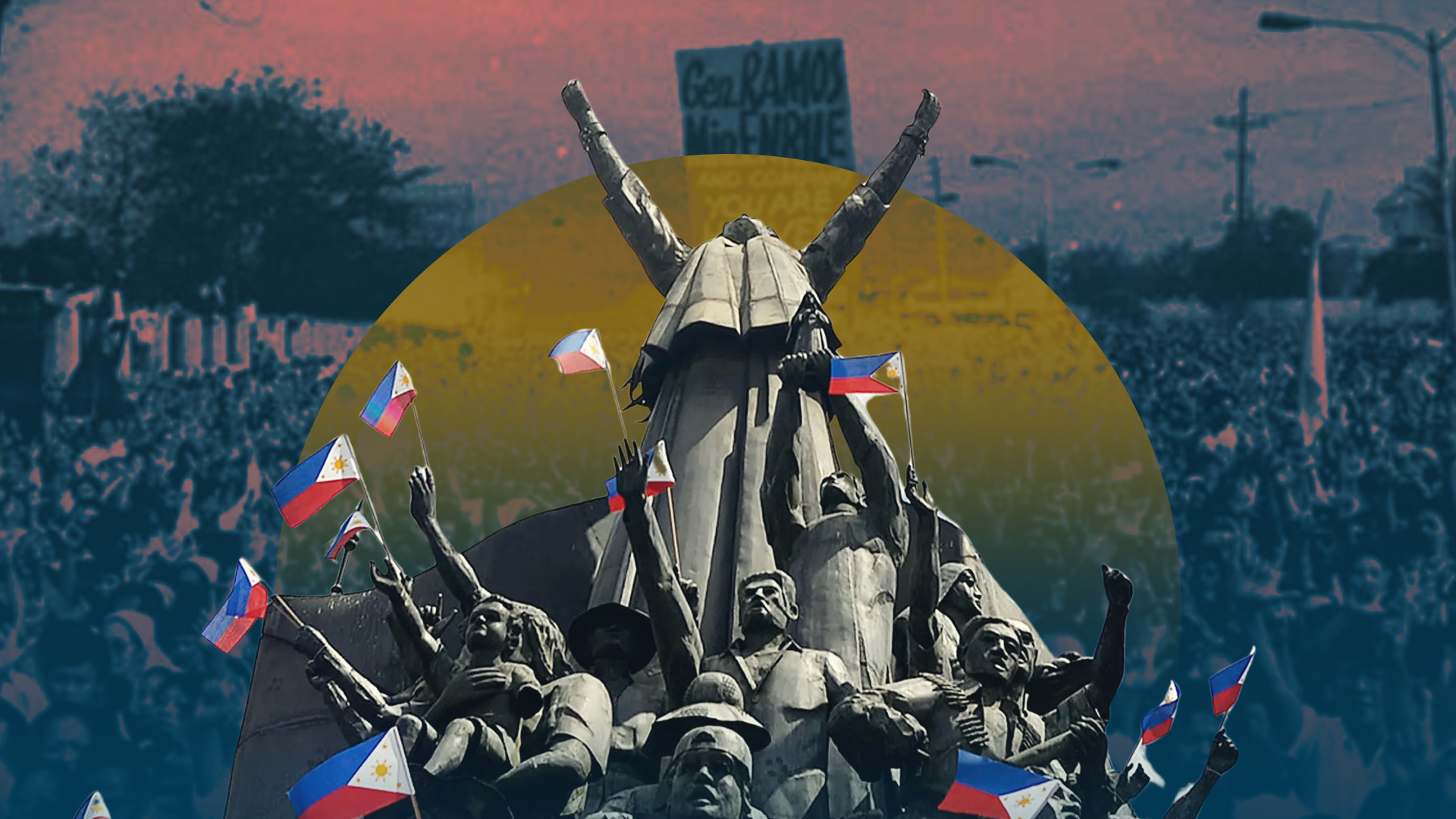
Ninoy’s widow, Corazon “Cory” Aquino, was drafted to run as the opposition candidate after being presented with a petition containing over one million signatures. The election was marred by blatant fraud; while official results favored Marcos, the volunteer group NAMFREL showed Aquino leading, prompting 30 computer technicians to walk out in protest of result tampering. The final trigger for the revolt occurred on February 22, when Defense Minister Juan Ponce Enrile and General Fidel Ramos defected from the regime and took a stand at military camps after their secret coup plot was leaked.
In a historic moment of ecclesiastical intervention, Manila Archbishop Jaime Cardinal Sin used Radio Veritas to appeal to the public to go to EDSA and shield the defecting soldiers. Millions of Filipinos responded, forming massive human chains between Camp Aguinaldo and Camp Crame to block the path of approaching tanks. Protesters employed nonviolent resistance, famously offering flowers, food, and cigarettes to soldiers while singing and praying to prevent bloodshed. Despite military orders to repress the crowd, the revolution remained bloodless, with no shots fired by the troops who eventually joined the people’s cause.
On February 25, 1986, two separate inaugurations were held; however, Marcos’s live coverage was cut when the television transmitter was taken down, and the U.S. government later facilitated the Marcos family’s escape to Hawaii. Immediately after they fled, jubilant citizens marched into Malacañang Palace, where they discovered the family’s opulent wealth and evidence of their luxurious lifestyle. Cory Aquino was inaugurated as the 11th and first female president of the Philippines, and she quickly established the Presidential Commission on Good Government (PCGG) to recover the billions in ill-gotten wealth amassed during the dictatorship. Legal efforts for restitution continued for decades, including a 1998 Honolulu court ruling that awarded $1.9 billion in damages to more than 9,500 victims of Martial Law atrocities. However, the transition to democracy was not seamless, as the new government faced several coup attempts led by the same military factions that had originally helped topple the dictator.
The legacy of the EDSA Revolution is often described as “unfinished” because deep-seated social ills like corruption, economic inequality, and extrajudicial killings have persisted across every administration since 1986. Despite their initial exile, the Marcos family returned to political power, with Ferdinand “Bongbong” Marcos Jr. winning the presidency in 2022 and his sister Imee Marcos serving as a Senator. There are ongoing concerns regarding the sanitization of history, highlighted by the 2024 removal of EDSA Day as a public holiday and efforts to whitewash the human rights violations of the Martial Law era. While the PCGG continues to pursue an estimated $10 billion in unrecovered wealth, the revolution’s most vital achievement remains the restoration of a democratic space that allows for freedom of speech and popular elections, serving as a living invitation for citizens to defend their democracy.